Rwanda - Agriculture
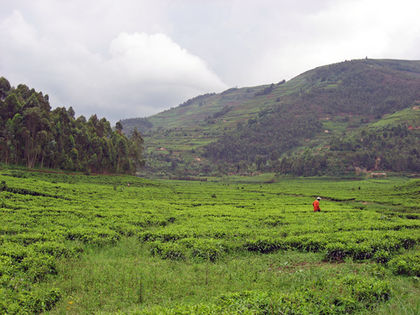
In 1999, about 91% of Rwanda's economically active population earned their living, directly or indirectly, from agriculture. Except for heavily eroded regions, the soil has a good humus content and is fertile, especially in the alluvial valleys and in the volcanic soils of the northwest. About 1.1 million hectares (2.8 million acres) are under cultivation. Subsistence agriculture predominates, and the basic agricultural unit is the small family farm of about one hectare (2.5 acres).
In 1999, the principal food crops (in tons) were plantains, 2,897,000; sweet potatoes, 863,000; cassava, 317,000; potatoes, 176,000; dry beans, 140,000; and sorghum, 108,000. The corn crop came to 55,000 tons and the sugarcane crop to 40,000 tons. The plantain crop is used principally for making beer and wine. Coffee, grown by some 600,000 smallholders, is the chief cash crop; in 1999, 9,000 tons were produced. Tea production came to about 13,000 tons in 1999. Coffee and tea together generally contribute 80% to export earnings. Rwanda also exports quinine and pyrethrum.
Rwanda has had devastating periods of famine. In 1928–29, more than 400,000 Rwandans died or were forced to migrate; in 1943–44, the figure was 300,000. Government planning has aimed at mitigating such catastrophes by striving for annual increases of food-crop production. Included in the government effort has been the introduction of rice cultivation by agronomists from Taiwan and China. Export diversification has been encouraged by the government, including production of alternatives such as sunflowers, and fruits and vegetables for the European winter market. In 2001, agricultural products accounted for 39% of exports, but there was an agricultural trade deficit of $32.8 million.
~SmItHeRs~
I'd also like to know the crop in which Rwanda can have a comparative advantage.
And that will help them to be known and get supported if their projects are real tengible.
Please help them to do it quickly.