Philippines - Agriculture
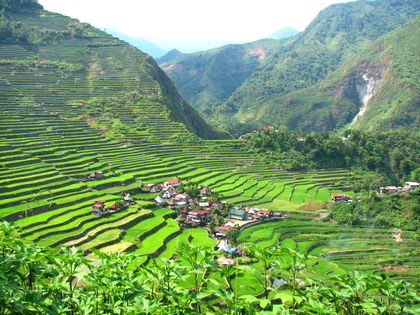
The Philippines is still primarily an agricultural country despite the plan to make it an industrialized economy by 2000. Most citizens still live in rural areas and support themselves through agriculture. The country's agriculture sector is made up of 4 sub-sectors: farming, fisheries, livestock, and forestry (the latter 2 sectors are very small), which together employ 39.8 percent of the labor force and contribute 20 percent of GDP.
The country's main agricultural crops are rice, corn, coconut, sugarcane, bananas, pineapple, coffee, mangoes, tobacco, and abaca (a banana-like plant). Secondary crops include peanut, cassava, camote (a type of rootcrop), garlic, onion, cabbage, eggplant, calamansi (a variety of lemon), rubber, and cotton. The year 1998 was a bad year for agriculture because of adverse weather conditions. Sector output shrank by 8.3 percent, but it posted growth the following year. Yet, hog farming and commercial fishing posted declines in their gross revenues in 1999. The sector is burdened with low productivity for most of its crops.
The Philippines exports its agricultural products around the world, including the United States, Japan, Europe, and ASEAN countries (members of the Association of Southeast Asian Nations). Major export products are coconut oil and other coconut products, fruits and vegetables, bananas, and prawns (a type of shrimp). Other exports include the Cavendish banana, Cayenne pineapple, tuna, seaweed, and carrageenan. The value of coconut-product exports amounted to US$989 million in 1995 but declined to US$569 million by 2000. Imported agricultural products include unmilled wheat and meslin, oilcake and other soybean residues, malt and malt flour, urea, flour, meals and pellets of fish, soybeans and whey.
One of the most pressing concerns of the agricultural sector is the rampant conversion of agricultural land into golf courses, residential subdivisions, and industrial parks or resorts. In 1993 the nation was losing irrigated rice lands at a rate of 2,300 hectares per year. Small land-holders find it more profitable to sell their land to developers in exchange for cash, especially since they lack capital for seeds, fertilizers, pesticides, and wages for hiring workers to plant and harvest the crops. Another concern is farmers' continued reliance on chemical-based fertilizers or pesticides that have destroyed soil productivity over time. In recent years however, farmers have been slowly turning to organic fertilizer, or at least to a combination of chemical and organic inputs.
Environmental damage is another major concern. Coral-reef destruction, pollution of coastal and marine resources, mangrove forest destruction, and siltation (the clogging of bodies of water with silt deposits) are significant problems.
The agriculture sector has not received adequate resources for the funding of critical programs or projects, such as the construction of efficient irrigation systems. According to the World Bank, the share of irrigated crop land in the Philippines averaged only about 19.5 percent in the mid-1990s, compared with 37.5 percent for China, 24.8 percent for Thailand, and 30.8 percent for Vietnam. In the late 1990s, the government attempted to modernize the agriculture sector with the Medium Term Agricultural Development Plan and the Agricultural Fisheries Modernization Act.
The fisheries sector is divided into 3 sub-sectors: commercial, municipal, and aquaculture (cultivation of the natural produce of bodies of water). In 1995, the Philippines contributed 2.2 million tons, or 2 percent of total world catch, ranking it twelfth among the top 80 fish-producing countries. In the same year, the country also earned the distinction of being the fourth biggest producer of seaweed and ninth biggest producer of world aquaculture products.
In 1999 the fisheries sector contributed P80.4 billion at current prices, or 16 percent of gross value added in agriculture. Total production in 1999 reached 2.7 million tons. Aquaculture contributed the most, with 949,000 tons, followed closely by commercial fishing with 948,000 tons, and municipal fisheries with 910,000 tons. Domestic demand for fish is substantial, with average yearly fish consumption at 36kg per person compared to a 12kg figure for consumption of meat and other food products.
I would like to know what are the the kinds of veggies that they can grow well and please tell me about what suite best coz of the weather.Where can i buy some good seeds,incase there were some veggies that we can grow.
Any help is high appreciated.
Sincerely,
C2
thanks
i will appreciate response
GOOD DAY...
I WANT OT ASK IF WHAT ARE THE WAYS TO PREVENT RICE FIELD INSECTS TO ATTACK DURING OUR PLANTATION...
(NEGROS ORIENTAL)
I LOOK FORWARD FOR THE REPLY REGARDING MY CONCERN... THANK YOU...
mytraderjuan.com
i would to ask what is the New discovered crop varieties of the Philippines?, especially the rice, corn, vegetable crops, plantation crops and ornamental crops.
than you,
We used to be the trainers of farming, and yet through technology, we forgot the natural way of farming, we adopt inorganic farming cause we need a huge amount of supply, in line with this our land became acidic and our yield decreased that why we import t our neighboring country. Which uses natural way such as organic farming. we are now suffering from using this chemicals to produced our food. It's about time that we go back to basics, go back to nature and learn how nature created his yields. Of course some of us would probably think of the old ways of organic farming which is not in immediate result, it takes time, Heavy, to many works to be done.
Today some company has step up to make organic farming as easy as the synthetic fertilizer. It is been process through latest technology such as Nano technology that cuts out the time needs for the plants to utilized it. We can help our farmers gain and restore the smiles in their faces. I am Talking about WinCrop. If you want to know more you can send it to my email. I am gladly to help.
i just want to know the updated/latest issues with regards of the Philippine Agriculture..
im waiting for your response...
agriculture in philippines are good its because of its climate where it can produce a good quality of corps which is exported outside the philippines as a raw material or just simply consumable but inconsistent sometimes especially bothered by bad weather(typhoons) lazines and corruptions sometimes..tnx.
The source of delima are those bad politicians, their corruption tactics and policies. Second, when small farmers plant and cultivate the land, here comes the NPA who will take your products. But we are already late. with Global 7 billion populations with interest in technology advancement the world will be in huge hunger. You take care of your family, they take care of them, they will source you until you die. Thats the game now and forever.
now body understand them, they will establish strategic planning for agriculture but its only artificial so that they can divert the funds into unknown accounts. You will see. You really want the Philippines to come back again into agriculture. The government should draft a policy that OFW or any Filipino has the right to present the country to any foreign investor or are authorized to conduct investment opportunity to bring foreign investors, that the government only support them not interfering for their self interest
just going to ask will it be good to start a fruit farm business as a source of living? given the present climate here in the philippines.
hoping for your response
thanks
i just want to ask if there are new agricultural products in the phil. :)
Read more: Philippines Agriculture, Information about Agriculture in Philippines
Please respond. I have to do an assignment on this! :) Thanks
The Philippines is blessed with fertile soil and ideal growing weather ,, ,,,for basic survival we have everything compared to other countries where nature is harsh,,, all we need to do is take care of our natural habitat and it will continue to provide us all the necessities of life
Im just wanna ask if what are the problems of agriculture in the past up to now in present?
u helped with my school work
thanx
u r awesome
i am awesome
we all are awesome
i need help regarding related literature and studies both foreign and local regarding our research entitled "perception of students and parents towards BS in Agriculture: Basis for a proposed Intervention program"
part of the intervening variables are student-respondent demographic profile such as age, gender and economic status.
your help is highly appreciated.
thank you
There are many broken families because parents cannot take good care of their children because they work abroad, because the Philippine government cannot afford to give them jobs here.
The Philippines is not a good mother because she allows her children to move away. A Hen is much better because the hen collects her chicks under her wings protecting them.
I just wanna know, how does agriculture help to uplift the economy of our country?
And Also to keep peopel bussy and mabye not import so much
And the food Will be cheaper in your contry
But sad as it is to see so much land waste
There is so much good farm land there is undevelop
Wich could be good farming land for cheap monye
But not manye take that chance
But With a pupolation grow on 2% per year
Out of 100 million peopel there Will be a need for a lot food in the future !!
So hope sombody Will Care soon to develop a morden agriculutre in phillippines !!
Really hope pilipinos get toghter soon and
Do somting good and start caring in-sted of fighting
And as long it is that our contry can't get investorer to put up factories and get peopel imployed.
And we Will still have a huge labor force With no work !!
And in my opinion ... I dont tink peopel outsider Will cuntinio to employ us if we not get our shit toghter
Right now i can't see any hope for us pilipino !!
And its to sad
We are all strugling to survive Except our goverment employer
Hope our farmers not give up .. So we still have food on our tabel
Appreciate any advice.
Thank you
Philippines is good for Agri products but people of the Philippines enjoying monkey business (i.e. vices or bisyo)
please back to our beloved land and cultivate, our people will get healthy food and affordable food in everyday live. ty we are blessed.
what information do filipino farmers need to have better rice production and sales?
Thank you
your feedback would be a great help for a student like me. thankyou
Thank You in advance 😊
I am a new faculty researcher in a certain university and I am acquainting myself with Philippine journals and their statuses and the basics of research publications within or without the country.
I have known that a researcher is mandated, said to me by my head, to give a copy of their work to a Philippine government agency to which the research papers appropriately belong to, according to the nature of the research study. I am currently making my proposal about groundnut (Arachis Hypogaea L.) properties and its effective shelling operation. The first main problem that is extremely to be refrained from is the duplication or redundancy of researches. That is why I look for different Philippine journals and do a literature review. However, I didn't find any closely related to my proposal.
The reasons for that are: maybe the study that I am undertaking is new, or, most probably the study has been published in international journals. Whichever the case, since they are required to give a copy of their research to a suitable Philippine government agencies, then the Philippine government agencies must have ample amount of information.
So you see what the problem is: the difficulty of seeking research studies about Philippine settings done by Filipino researchers. It is because those studies are distributed among different Philippine agencies. Now what I propose as a solution is a central data base for all research studies, that are in different Philippine agencies, grouped together according to which categories they belong.
It is wasteful in resources to redo studies that have already been done, but it cannot be easily checked because of the difficulty of doing it since those studies are scattered everywhere. Please let me know if there's something I don't understand about the current said current situations. I just wanna help.
Sincerely yours,
Weber
tnx
your kind response will appreciated.