BARBADOS
COUNTRY OVERVIEW
LOCATION AND SIZE.
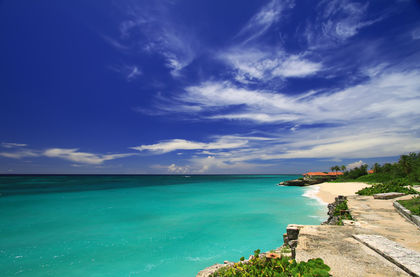
Barbados is an island situated between the Caribbean Sea and the Atlantic Ocean, northeast of Venezuela and east of the Windward Island chain. It covers an area of 430 square kilometers (166 square miles), roughly 2.5 times the size of Washington, DC. Its coastline is 97 kilometers (60 miles) in length and its capital, Bridgetown, is situated at a natural harbor on the southwest coast of the island.
POPULATION.
The population of Barbados was estimated at 274,540 in mid-2000, representing a growth rate of 0.55 percent over the preceding year. The average annual rate of population increase from 1995 stands at 0.3 percent. At current rates, the island's population will reach approximately 288,000 by 2010. The government wants to restrict population growth because Barbados is one of the most densely populated countries in the world (estimated at 619 people per square kilometer in 1997, or 1,603 people per square mile). There is a well-organized family planning program in the island and the birth rate, at 14.45 per 1,000 population in 2000, is one of the lowest in the region. The migration rate was extremely high until the 1970s but, at 0.32 migrants per 1,000 population, is now low by regional standards.
The age structure of Barbadians reflects government planning policy and high living standards, with only 22
DEPENDENCIES
Barbados has no territories or colonies.
BIBLIOGRAPHY
Caribbean Development Bank. Annual Report 1999 . Barbados, 2000.
Economist Intelligence Unit. Country Profile: Bermuda, Bahamas, Barbados, Netherlands Antilles, Aruba, Turks & Caicos Islands, Cayman Islands, British Virgin Islands . London: Economist Intelligence Unit, 2001.
Government of Barbados Information Network (GOBINET). <http://barbados.gov.bb> . Accessed September 2001.
International Monetary Fund. <http://www.imf.org/external/np> .
U.S. Central Intelligence Agency. World Factbook 2001. <http://www.odci.gov/cia/publications/factbook/index.html> . Accessed August 2001.
U.S. Department of State. Background Notes: Barbados, August 2000. <http://www.state.gov/www/background_notes/barbados_0008_bgn.html> . Accessed September 2001.
U.S. Department of State. FY 2001 Country Commercial Guide: Barbados. <http://www.state.gov/www/about_state/business/com_guides/2001/wha/index.html> . Accessed September 2001.
—James Ferguson
CAPITAL:
Bridgetown.
MONETARY UNIT:
Barbados dollar (BDS$). One dollar equals 100 cents. There are coins of 1, 5, 10, 25 and 50 cents and 1 dollar, and notes of 1, 2, 5, 10, 20, 50, and 100 dollars. The Barbados dollar is pegged to the U.S. dollar at the rate of BDS$1:US$0.49771, or US$1:BDS$2.011.
CHIEF EXPORTS:
Sugar and molasses; rum; other food and beverages; chemicals; electrical components; and clothing.
CHIEF IMPORTS:
Consumer goods, machinery, foodstuffs, construction materials, chemicals, fuel, and electrical components.
GROSS DOMESTIC PRODUCT:
US$4 billion (purchasing power parity, 2000 est.).
BALANCE OF TRADE:
Exports: US$260 million (2000 est.). Imports: US$800.3 million (2000 est.).