Mali - Agriculture
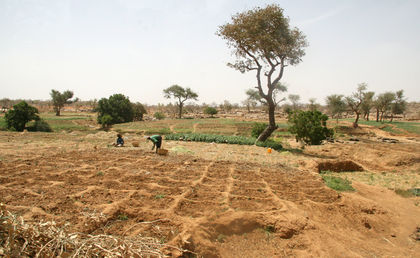
Only the southern part of Mali is suited to farming, and less than 2% of Mali's area is cultivated. Agriculture accounted for about 45% of GDP, 21% of exports, and over 80% of the active labor force in 2001. Millet, rice, and corn are the basic food crops. Millet and sorghum are cultivated mainly in the areas around Ségou, Bandiagara, and Nioro. Paddy rice is cultivated on irrigated farms in the area around Mopti, Ségou, and Niafounké. Cereals are produced for subsistence by 90% of farmers. Peanuts are grown in the Sudanese zone, as are cotton, fruits, vegetables, and henna. The shea tree nut, which grows wild, is exploited by Malians for its oil.
Output fluctuates widely as a result of the amount and distribution of rainfall. In 1999, cereal production was estimated at 2,149,000 tons. Production estimates in 1999 for principal agricultural crops grown for domestic use included millet, 641,000 tons; sorghum, 559,000 tons; sugarcane, 303,000 tons; corn, 341,000 tons; cassava, 10,000 tons; and sweet potatoes, 16,000 tons. The rice production figure was 589,000 tons.
Cotton is Mali's major foreign exchange earner. In 1999, Mali had a production of 218,000 tons. Buoyant world prices have increased foreign exchange earnings from cotton. In 2001, Mali's trade surplus in agricultural products was $46.7 million.
The Niger Office, now a state-controlled agency, was set up in 1932 to aid in improving cotton and rice production. It developed the irrigation and modern cultivation of some 81,000 ha (200,000 acres) in the dry inland delta of the Niger; in 1998, about 138,000 ha (341,000 acres) in Mali were irrigated. The infrastructure includes a dam (2.6 km wide/1.6 mi), irrigation canals, ditches and dikes, and such installations as housing stores, warehouses, rice and oil mills, cotton-ginning factories, sugar refineries, soap factories, research stations, schools, and dispensaries. Growing cotton in irrigated fields did not succeed and was abandoned in 1970. All cotton is now grown in nonirrigated fields in the regions of Bamako, Ségou, and Sikasso.
Mali?