Switzerland - Foreign trade
Switzerland's annual trade balance is habitually in arrears, owing to the economy's reliance on large quantities of imported raw materials for industry. Switzerland's export commodities are split into two categories: machinery sold to other manufacturers, and commodities used by consumers. The country exports a large number of the world's watches and clocks. The top 10 exports are listed below:
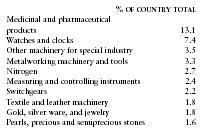
| % OF COUNTRY TOTAL | ||
| Medicinal and pharmaceutical | ||
| products | 13.1 | |
| Watches and clocks | 7.4 | |
| Other machinery for special industry | 3.5 | |
| Metalworking machinery and tools | 3.3 | |
| Nitrogen | 2.7 | |
| Measuring and controlling instruments | 2.4 | |
| Switchgears | 2.2 | |
| Textile and leather machinery | 1.8 | |
| Gold, silver ware, and jewelry | 1.8 | |
| Pearls, precious and semiprecious stones | 1.6 |
In 2000 Switzerland's imports were distributed among the following categories:
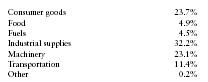
| Consumer goods | 23.7% |
| Food | 4.9% |
| Fuels | 4.5% |
| Industrial supplies | 32.2% |
| Machinery | 23.1% |
| Transportation | 11.4% |
| Other | 0.2% |
Principal trading partners in 2000 (in millions of US dollars) were as follows:
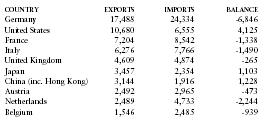
| COUNTRY | EXPORTS | IMPORTS | BALANCE |
| Germany | 17,488 | 24,334 | -6,846 |
| United States | 10,680 | 6,555 | 4,125 |
| France | 7,204 | 8,542 | -1,338 |
| Italy | 6,276 | 7,766 | -1,490 |
| United Kingdom | 4,609 | 4,874 | -265 |
| Japan | 3,457 | 2,354 | 1,103 |
| China (inc. Hong Kong) | 3,144 | 1,916 | 1,228 |
| Austria | 2,492 | 2,965 | -473 |
| Netherlands | 2,489 | 4,733 | -2,244 |
| Belgium | 1,546 | 2,485 | -939 |
Also read article about Switzerland from Wikipedia
Comment about this article, ask questions, or add new information about this topic: