Fiji - Foreign trade
Like most developing countries that export primarily basic commodities—which are subject to wide market price fluctuations—and import high-valued manufactured products, Fiji has traditionally run a merchandise trade deficit. The years of 1995 and 1996 saw unprecedented trade surpluses while the 1998 merchandise trade deficit was $263 million. In 2000, however, the country reversed again to a trade surplus, this time totaling $227 million.
Clothing production dominates Fiji's export commodities, with over a third of export revenues tied to the apparel trade (33%). Sugar and honey are in second place in export sales (24%). Other exports include fish (7.2%) and gold (7.0%). Most of Fiji's exports go to Australia, the United Kingdom, and New Zealand.
In 1994, Fiji's imports were distributed among the following categories:
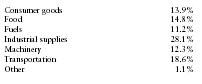
| Consumer goods | 13.9% |
| Food | 14.8% |
| Fuels | 11.2% |
| Industrial supplies | 28.1% |
| Machinery | 12.3% |
| Transportation | 18.6% |
| Other | 1.1% |
Principal trading partners in 1998 (in millions of US dollars) were as follows:
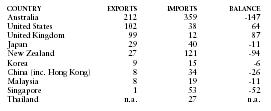
| COUNTRY | EXPORTS | IMPORTS | BALANCE |
| Australia | 212 | 359 | -147 |
| United States | 102 | 38 | 64 |
| United Kingdom | 99 | 12 | 87 |
| Japan | 29 | 40 | -11 |
| New Zealand | 27 | 121 | -94 |
| Korea | 9 | 15 | -6 |
| China (inc. Hong Kong) | 8 | 34 | -26 |
| Malaysia | 8 | 19 | -11 |
| Singapore | 1 | 53 | -52 |
| Thailand | n.a. | 27 | n.a. |
2. What portion of Fiji trade is conducted by means of shipping?